
HCDI Foundation Certificate
Chapter 7. Reading evidence without over-interpreting it
Source note
Source basis - S1, physical PDF page 10.
HCDI methodology fact (the Evidence Source Map, as amended 20 October 2026; classification to be confirmed) and HCDI governance rule (Unit 1.7). A practitioner records how strongly each piece of evidence stands up. There are five states:
| Pilot state | Source meaning |
| Verified | Supported by a document, alone or with a second independent source. |
| Corroborated | Second independent source; no document. |
| Claimed - uncorroborated | One statement without confirmation. |
| Missing | Requested and not provided. |
| Contradicted | Sources disagree; public conflict workflow applies. |
Source qualification - the pilot marks classification of the amended Evidence Source Map as pending. These states are not numerical weights.
Three rules follow, and they matter more than the table.
1. Absence is never a low score. An indicator with no linked evidence cannot be scored. It is recorded as not evidenced, it leaves every denominator, and the report discloses it. A gap in evidence is not proof of a weakness.
2. The states are an ordering, not a weighting. A verified item does not multiply a score. Evidence decides whether something may be scored and how the report caveats it. It does not decide how large the score is.
3. A number must be read with its basis. The report prints coverage beside the score for that reason. Common Error. Reading "not evidenced" as "failed". It means "could not be scored for lack of linked evidence".
Evidence strength is claim specific
Basis - general professional knowledge and editorial explanation. External references are identified explicitly; this section adds no HCDI rule.
A policy can establish approved wording while leaving implementation unanswered. Several reports may reproduce one original statement. Record what each source directly supports and what remains uncertain. The pilot five-state source has classification pending; this book preserves that status rather than creating an approved standard. Evidence labels are not numerical confidence weights. Availability of evidence and substantive performance remain distinct questions.
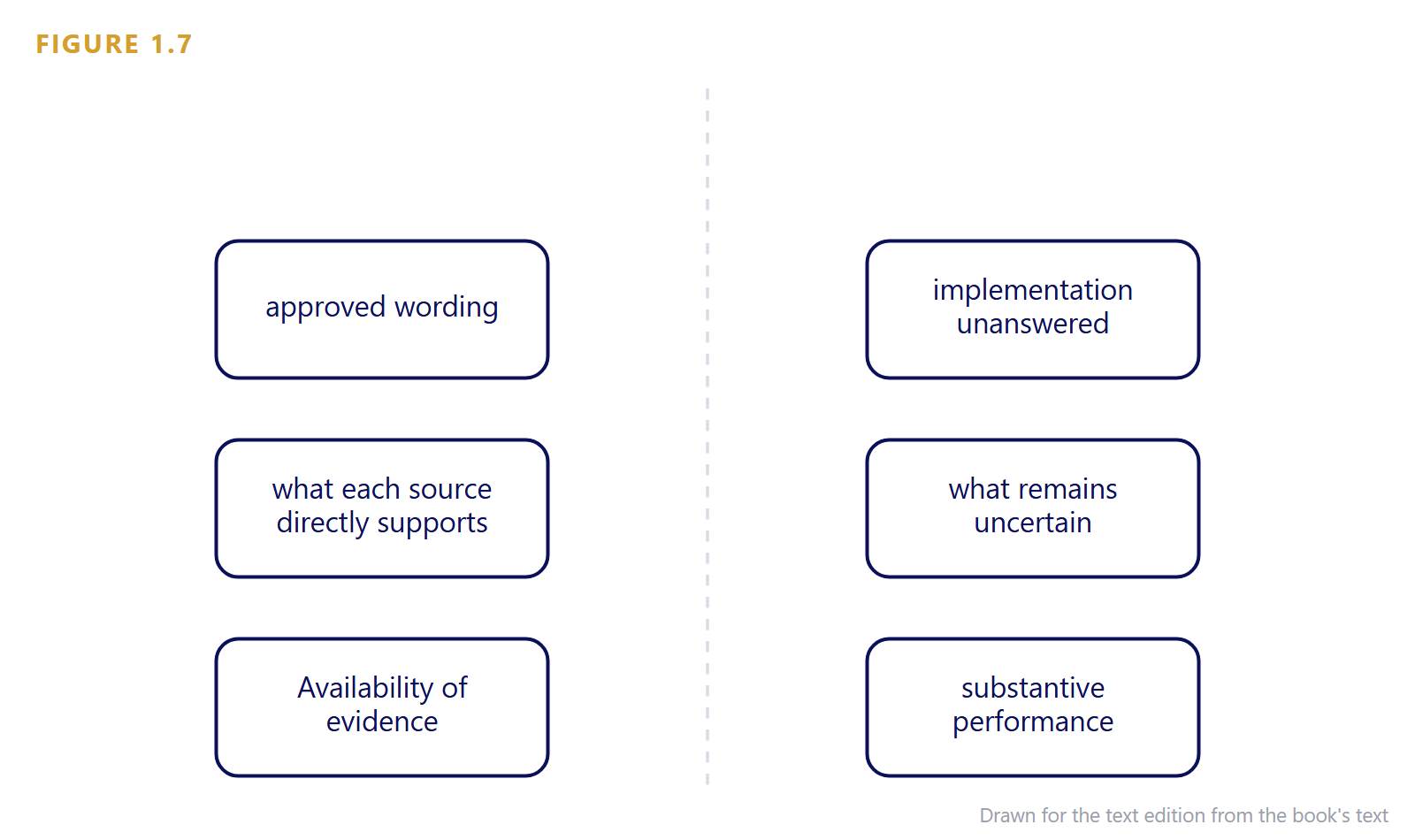
Figure 1.7 Evidence strength is claim specific. Original conceptual illustration; arrows organise the discussion and do not establish a validated causal effect or a scoring procedure.
Original exercise L1 E07
Basis - original fictional exercise. The organisation, events and any numbers are invented for learning. No HCDI result is assigned.
A register lists an escalation policy. A training slide quotes the register. A manager says it has never been used.
| Analytical task | Learner response required |
| Observation | Identify what the stated record directly establishes. |
| Inference | State the interpretation that still needs support. |
| Alternative | Identify a plausible alternative or missing context. |
| Authority | Identify the relevant credential or role boundary. |
Question - Do the first two items independently demonstrate implementation?
Worked answer: Part G, exercise L1 E07.