
HCDI Foundation Certificate
Chapter 13. From observation to number
Source note
Source basis - S1, physical PDF page 13.
HCDI methodology fact (Unit 1.3) and general professional knowledge. HCDI turns observation into number in steps that a reader can follow. An assessor scores each indicator from 1 to 5 against a written description for each score, and records the rationale. Individual scores are then combined into pillar and dimension scores on a 0 to 100 scale, and an overall result. The readiness scale runs from Critical Risk to Exceptional HumanCorp Readiness. The public page names only those two ends, and so does this manual. A number built this way is a summary of structured professional judgement, and not a measurement in the way a length is. It is useful because it is structured, recorded and reviewable. It is limited because it rests on evidence, and the evidence has a coverage and a quality that the report prints beside it.
Professional Judgment. Treat a score as a conclusion that someone reached from evidence, and ask to see the basis, not as a fact about the organisation.
Numbers have a construction history
Basis - general professional knowledge and editorial explanation. External references are identified explicitly; this section adds no HCDI rule.
Numerical summaries compress observations through definitions and inclusion choices. More decimal places do not create evidence. Comparisons need comparable populations, periods and methods. A reader can ask what evidence was available and what could not be assessed without reconstructing protected rules. This book supplies no weights, band boundaries, gate conditions or fit formula.
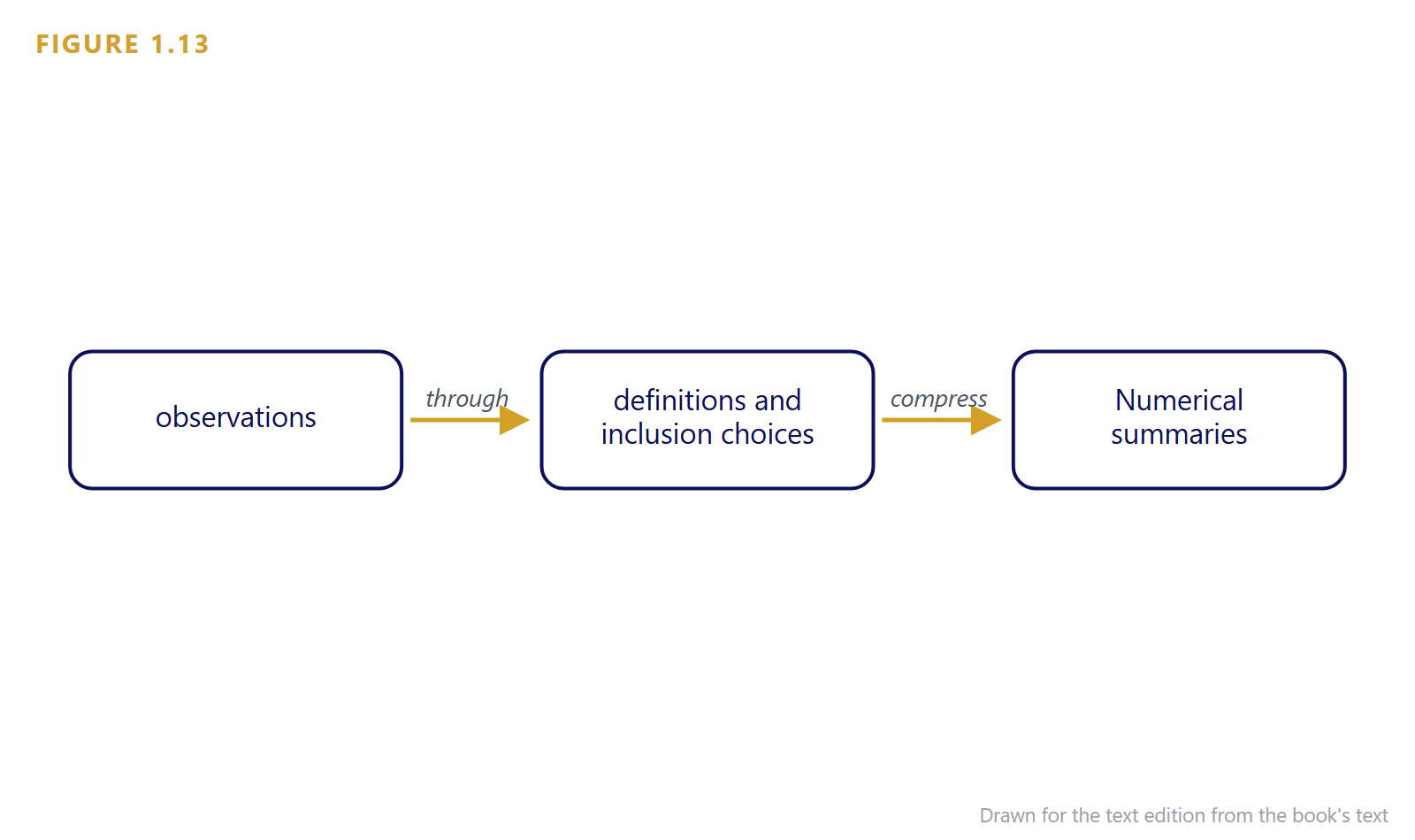
Figure 1.13 Numbers have a construction history. Original conceptual illustration; arrows organise the discussion and do not establish a validated causal effect or a scoring procedure.
Original exercise L1 E13
Basis - original fictional exercise. The organisation, events and any numbers are invented for learning. No HCDI result is assigned.
Two dashboards show the same number. One has broad evidence; the other discloses substantial gaps.
| Analytical task | Learner response required |
| Observation | Identify what the stated record directly establishes. |
| Inference | State the interpretation that still needs support. |
| Alternative | Identify a plausible alternative or missing context. |
| Authority | Identify the relevant credential or role boundary. |
Question - Do the numbers establish equivalent readiness?
Worked answer: Part G, exercise L1 E13.