
HCDI Foundation Certificate
Chapter 1. Why transactions fail for human reasons
Source note
Source basis - S1, physical PDF page 8.
general professional knowledge; external academic reference (Kotter, 1995). A transaction can be priced correctly and still disappoint. The causes are often human. People who hold the knowledge leave. Two organisations that looked alike on paper turn out to decide, argue and reward in different ways. A founder cannot step back. Staff learn about the change from rumour. The board of the combined business is not ready for obligations it did not have before. Kotter's study of transformation efforts is a useful lens. He described recurring errors, among them not creating a sense of urgency, under-communicating the vision, and declaring victory too soon (Kotter, 1995). It describes change efforts in general, not HCDI. The point for a decision-user is that these are patterns, and a pattern can be looked for in advance.
Evidence Check. When someone tells you a transaction failed for "cultural reasons", ask what was observed, by whom, and before or after the event. Human explanations are easy to give afterwards and hard to establish beforehand. That difficulty is the reason a structured assessment exists. Common Error. Treating a human risk as unmeasurable and therefore ignorable.
Further reading. Kotter (1995).
Causal explanations need a counterfactual
Basis - general professional knowledge and editorial explanation. External references are identified explicitly; this section adds no HCDI rule.
A disappointing transaction is an outcome, not an explanation. Identify the promised benefit, the work needed to obtain it and the people whose knowledge and cooperation that work depends on. A human mechanism connects a change in those conditions to an operational consequence. Changed authority can delay approvals; delayed approvals can postpone customer onboarding. Each connection is a hypothesis to investigate.
Reverse causation remains possible. Departures may damage performance, while poor performance may also cause departures. A market downturn may cause both. Interviews after a failure invite hindsight bias: people reconstruct a neat story around an outcome they already know. Compare dates, consider competing causes and look for similar teams with different exposures. Such comparisons improve reasoning but rarely create a clean experiment.
A financial model may assume service quality remains constant while supervisory capacity falls. That combination is an empirical dependency rather than an arithmetic identity. Ask which benefits depend on people and what evidence supports each dependency. Avoid universal merger-failure percentages unless the outcome, sample, time horizon and comparison are defined.
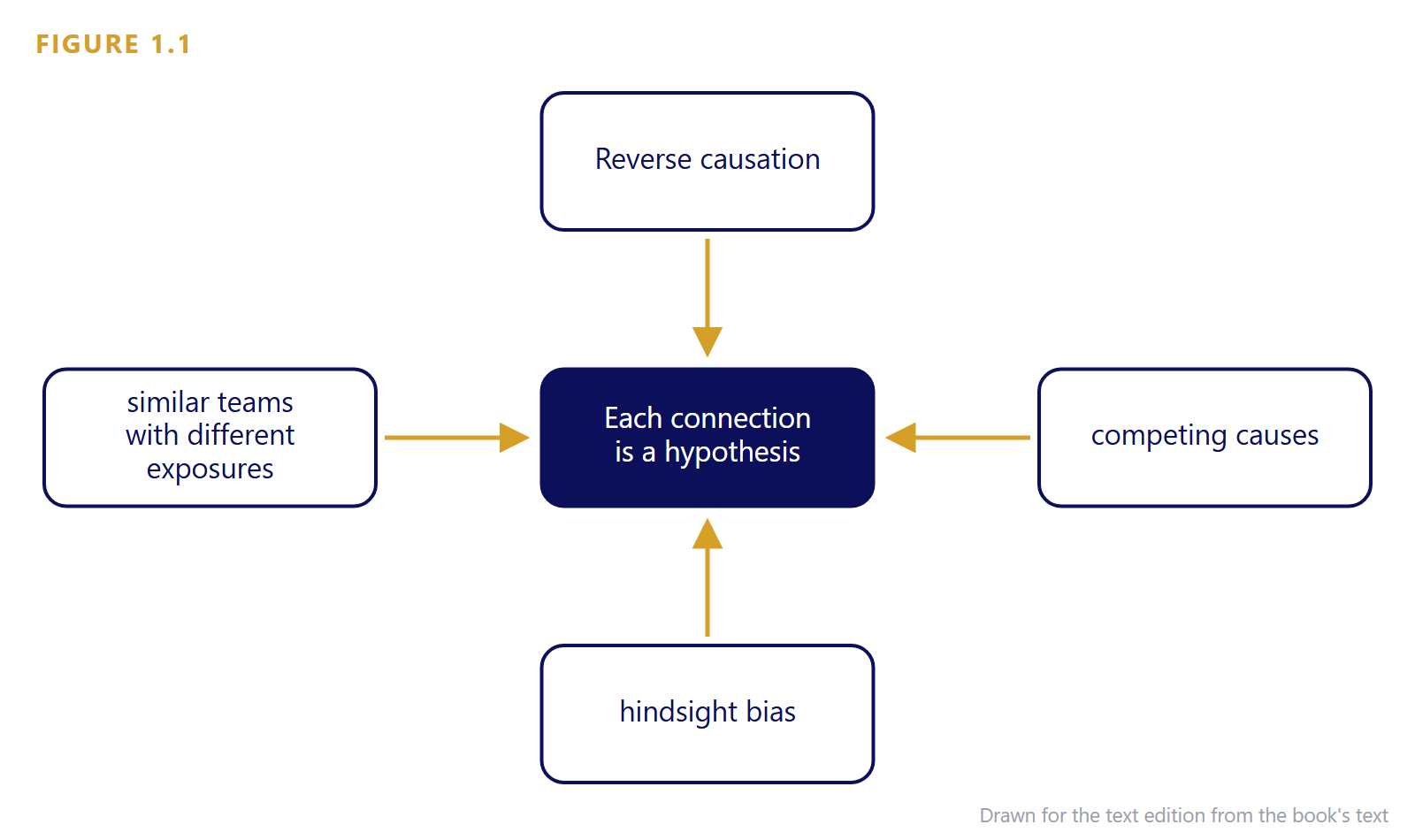
Figure 1.1 Causal explanations need a counterfactual. Original conceptual illustration; arrows organise the discussion and do not establish a validated causal effect or a scoring procedure.
Original exercise L1 E01
Basis - original fictional exercise. The organisation, events and any numbers are invented for learning. No HCDI result is assigned.
Aster Components buys a maintenance business. Four senior technicians leave after reporting lines change. Overtime rises before service delays appear. A supplier shortage also affects acquired and unchanged sites.
| Analytical task | Learner response required |
| Observation | Identify what the stated record directly establishes. |
| Inference | State the interpretation that still needs support. |
| Alternative | Identify a plausible alternative or missing context. |
| Authority | Identify the relevant credential or role boundary. |
Question - Does the sequence establish that the departures caused all delays?
Worked answer: Part G, exercise L1 E01.